Clutch Repair in Eustis, FL
The clutch is the connection between your engine and your manual transmission. Every time you press the pedal and engage a gear, the clutch disc, pressure plate, and flywheel are working together to transfer power smoothly without grinding components against each other. It is a wear item by design, and eventually every manual transmission vehicle needs clutch work.
At RJ Fox Automotive, we handle the full range of clutch services for manual transmission vehicles of all makes and models. From a clutch that is starting to slip to a pedal that has gone to the floor, we diagnose the problem accurately, give you a straight estimate, and do the job right the first time.
Warning Signs Your Clutch Needs Attention
Clutch wear is gradual, and most drivers adjust to small changes without realizing the clutch is deteriorating. By the time it fails completely, it has usually been sending signals for a while. Here is what to watch for.
- Slipping under load: the engine revs climb when you accelerate but the vehicle does not speed up proportionally, especially noticeable going uphill or when towing
- High engagement point: the clutch used to engage lower in the pedal travel and now it engages near the top, close to fully released
- Difficulty getting into gear: grinding or resistance when trying to select a gear even with the clutch fully depressed
- Clutch pedal feels different: spongy, loose, stiff, or with noticeably less resistance than usual
- Burning smell: particularly noticeable in stop-and-go traffic or on hills, a sign the clutch disc is overheating from slipping
- Shuddering on engagement: a vibration or judder when you let the clutch out from a stop, often pointing to contamination or a warped flywheel
- Noise when pressing the pedal: squealing or chirping when you depress the clutch often indicates a failing release bearing
If any of these sound familiar, it is worth getting the clutch inspected sooner rather than later. A clutch that is slipping is also a clutch that is wearing faster than normal. Addressing it before it fails completely gives you more options and usually a lower repair bill.
What Clutch Replacement Involves
A clutch replacement is a significant job because the transmission has to come out to access the clutch assembly. That is a substantial amount of labor, which is exactly why we recommend replacing all the wear components while we are in there rather than just the piece that has obviously failed.
A complete clutch job at RJ Fox Automotive includes the following.
- Transmission removal to access the clutch assembly
- Inspection of the clutch disc, pressure plate, release bearing, and pilot bearing
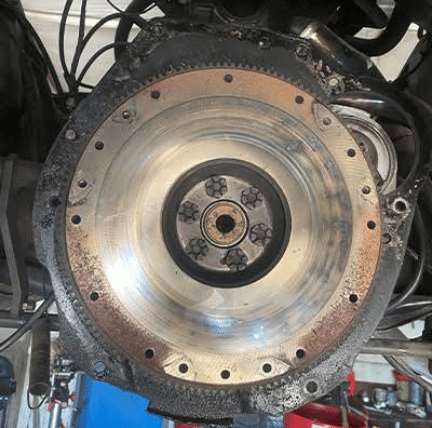
- Flywheel inspection for heat cracks, grooves, and surface condition
- Flywheel resurfacing if it is within spec, or replacement if it is not
- Installation of a new clutch disc, pressure plate, and release bearing
- Pilot bearing replacement
- Transmission reinstallation and alignment
- Clutch adjustment and hydraulic system check where applicable
- Road test to verify proper engagement, release, and shift quality
We always recommend replacing the full clutch kit rather than just one component. The parts all wear together and they all come out when the transmission comes out. Installing a new disc against a worn pressure plate, or leaving an old release bearing in place, means you will likely be back for the rest of the job sooner than you want to be.
Flywheel: Resurface or Replace?
The flywheel is the heavy rotating disc that the clutch disc presses against to transfer power. Over time the surface develops grooves, hot spots, and heat cracks from the friction and heat of normal clutch operation. A damaged flywheel surface will cause a new clutch to wear prematurely and can cause the shuddering and chatter that some drivers notice on engagement.
When we pull the transmission for a clutch job, we always inspect the flywheel carefully. If the surface is within the manufacturer's minimum thickness spec and the damage is limited to surface wear, resurfacing is the right call. If there are deep grooves, cracks, or the flywheel is below minimum thickness, replacement is the safer and more cost-effective long-term choice.
We will show you what we find and explain what we recommend. No unnecessary parts, but no shortcuts either.
Hydraulic Clutch Systems
Most modern manual transmission vehicles use a hydraulic clutch system rather than a cable. The pedal connects to a master cylinder that pushes hydraulic fluid to a slave cylinder, which in turn operates the clutch release fork. It works similarly to a brake system and has some of the same potential failure points.
If your clutch pedal feels spongy, has gone low, or you are losing pedal pressure, the hydraulic system may be the culprit. A leaking master cylinder, a failing slave cylinder, or air in the line can all cause pedal issues that feel like clutch wear but are actually hydraulic problems. We diagnose both sides of the system and make sure the hydraulic components are in good shape as part of any clutch service.
How Long Does a Clutch Last?
Clutch life varies widely based on driving style and conditions. A driver who rides the clutch in traffic or slips it frequently on hills will wear one out much faster than someone who drives primarily on the highway with clean engagements. General estimates range from 50,000 miles on the short end to well over 100,000 miles for careful drivers on easy routes.
There is no scheduled replacement interval for clutches the way there is for timing belts or spark plugs. The symptoms listed above are your guide. When the clutch starts showing signs of wear, it is time to have it looked at.